Troubleshooting the
RV DSI Furnace
The following descriptions are based on the Hydro Flame 8500 series furnaces, but the operating principles are similar for other manufacturers.
Low Battery Voltage
The furnace is designed to operate at voltages between 10.5 to 13.5 VDC. Low voltage will not run the blower motor at the proper speed to commence the ignition sequence. This is a safety feature that ensures the blower will be able to provide enough combustion air to operate the burner at it's designed efficiency.
Obstructed return air intake
Return air is the air that flows in to replace the heated air that the blower pushes out through the ducting. This air is pulled in by the furnace through louvered openings in the side of the furnace cabinet, and any items stored near these openings could interfere with this air flow.
The exhaust venting must be clear of all obstructions for proper furnace operation. Inspect the vents for insect or bird nests or other debris.
Low gas pressure
Low gas pressure will affect a burner in several ways. When a malfunctioning burner is encountered, the first step is to make sure the gas pressure is correct.
Gas pressure to a propane fueled appliance should be 10.5 to 11 inches of water column pressure. This is controlled by the main system regulator.
Time delay relay
This relay performs two separate jobs - one to handle the relatively high current needed to run the blower motor - and two, to allow the blower to run for 45 to 90 seconds after the thermostat is satisfied. This allows excess heat in the chamber to disipate before the blower stops.
The relay is normally open and should always have power from the circuit breaker. Only when power from the thermostat is present does the relay close after a 20 second delay. Power then flows to the blower motor. Newer models have a relay built into the circuit board and do not use this relay.
Blower motor
Next in the ignition sequence is the blower motor. It drives two squirel cage fans to provide separate air flow for the combustion process and for distributing the heated air to the coach. A heat exchanger is used to separate the heat from the burning gas while preventing exhaust gases from entering the living space.
Sail switch
The sail switch (air prover switch) is an on/off device. (normally in the off position) It gets it's name from the "sail" or paddle that is attached to the switch mechanism. As the blower comes up to speed, it blows air onto the sail with enough force to push the switch closed, thus allowing electrical current to flow to the next component in line.
It's job is to determine if there is adequate air flow for proper combustion to take place. If the battery voltage is low or the fan does not come up to 75 per cent of it's design speed, the sail switch will not close.
Possible causes of this malfuntion are: low battery, restricted return air inflow, restricted or inadequate outlet vents, restricted combustion air inlet or exhaust, faulty sail switch or faulty blower motor.
Limit switch
The limit switch is a simple temperature controlled switch. It's function is to monitor the combustion chamber heat level. If the temperature of the combustion chamber exceeds the preset limit, the switch will open and disrupt the flow of current to the circuit board, in effect, shutting down the main burner. Once the chamber temperature cools sufficiently, the limit switch resets. This initializes the ignition sequence and starts another cycle. This condition is referred to as "limiting".
Circuit board
The circuit board will not recieve power until the sail switch is closed by adequate air flow from the blower. The power must also flow through the limit switch.
When the circuit board is triggered by this current, it delays ignition for about 15 seconds to allow the blower to purge the combustion chamber of any unburned gases.
The circuit board then sends high voltage pulses to the electrode assembly, providing a series of sparks to ignite the gas/air mixture.
At the same time, the circuit board sends power to open the gas valves allowing the fuel to flow to the burner.
If everything is okay, the main burner ignites.
The circuit board monitors the burn cycle through a sensor that detects the presence of the flame. If the sensor does not detect a satisfactory flame within about 10 seconds, the board then shuts off the gas valves and discontinues the ignition spark.
Depending on the board design, it will try for ignition up to three times. Beyond that point, it goes into lockout mode, will not retry for ignition until reset and the blower will continue to run.
Burner assembly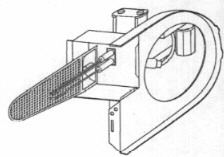
This illustration shows the burner assembly for the Hydroflame 8500 series furnace.
Many older furnaces used a very different burner configuation, but the principles remain the same.
The burner needs an ignition source (pilot or electronic spark), an appropriate combustion air supply, and proper fuel metering (orifice) to operate at it's designed capacity.
Electrode assembly
Electrodes are designed to provide an ignition spark - to initiate the burn - and to provide feedback to the circuit board when the flame is established. The propane flame creates a tiny electrical current which is sensed though the electrode assembly. This current is sent back to the circuit board, which in turn, decides if the flame is adequate. If not, the circuit board will shut down the burner.
The electrode assembly may have two or three probes, depending on the furnace make and model. Some systems used the extra probe for a ground circuit, others incorporated the ground circuit into the second probe. In any case, the gap between the spark probe and the ground (or other probe), should be 1/8 inch.
The electrodes must be clean and free of carbon or other deposits. Do not file or sand the surfaces as you will damage the protective coating and shorten the electrode life. Simply wipe off the contacts with a cloth and solvent, and replace them if needed.
Thermostat
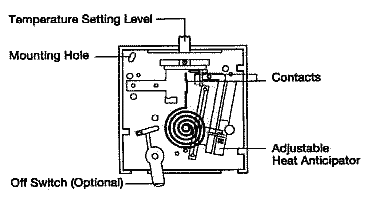 The thermostat is an on/off switch controlled by a bi-metal coil that senses the changes in
temperature and opens or closes an electrical contact. This signal is sent to the furnace to start or stop the
heating cycle.
The thermostat is an on/off switch controlled by a bi-metal coil that senses the changes in
temperature and opens or closes an electrical contact. This signal is sent to the furnace to start or stop the
heating cycle.